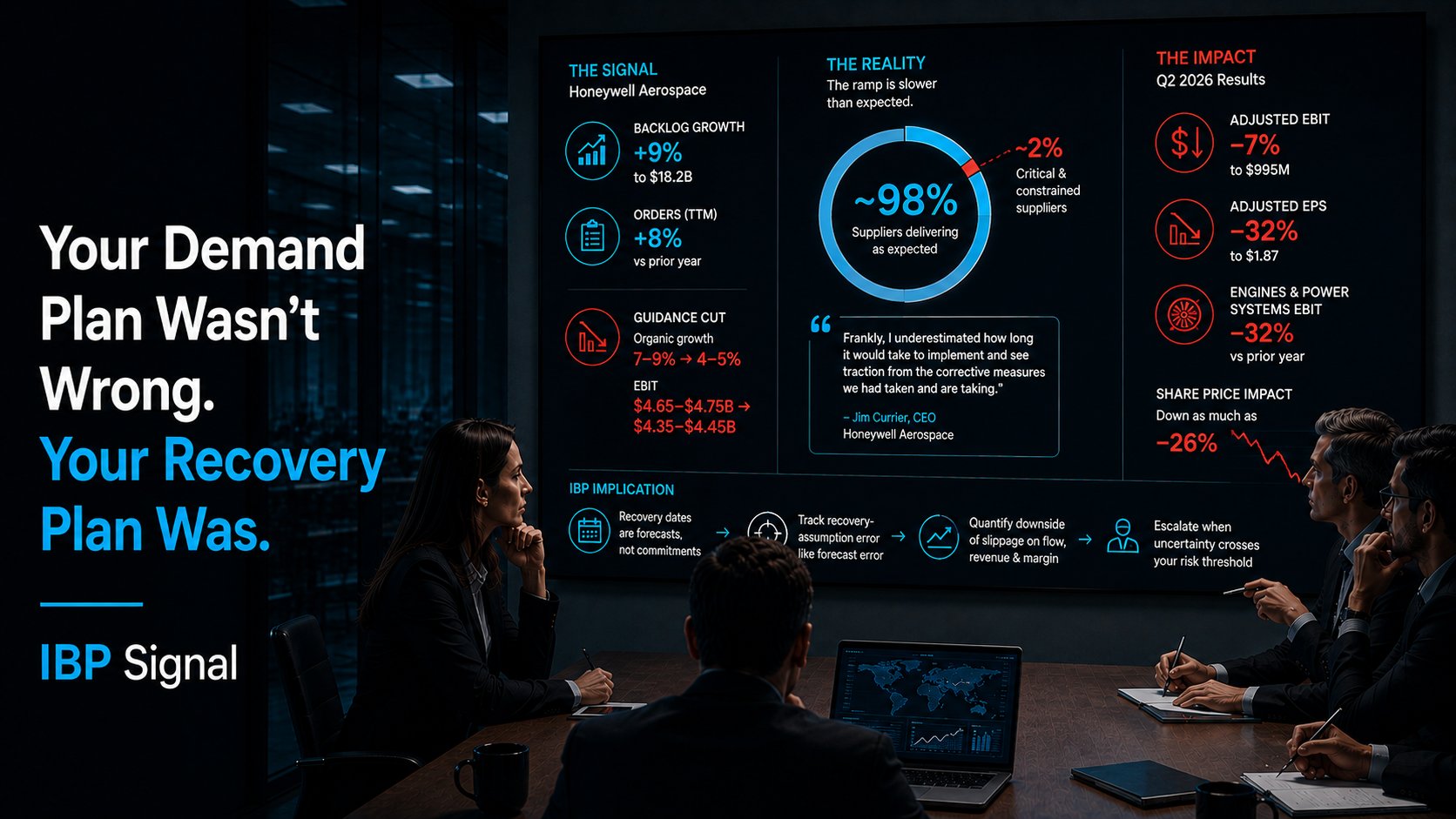
In early August 2026, Honeywell Aerospace reported strong demand signals: backlog grew 9% to $18.2 billion and trailing-twelve-month orders rose 8%. Then the newly independent company cut its 2026 organic growth guidance from 7–9% to 4–5% and adjusted EBIT guidance from $4.65–$4.75 billion to $4.35–$4.45 billion. Shares fell as much as 26% following the update.
Demand wasn't the problem. The recovery assumption was.
CEO Jim Currier acknowledged that "the ramp has not come through at the pace we had initially laid out," adding: "Frankly, I underestimated how long it would take to implement and see traction from the corrective measures we had taken and are taking." He said critical and constrained suppliers represented roughly 2% of the supply base, while the vast majority of the company's thousands of suppliers were delivering as expected.
Source: Stock Analysis, "Honeywell Aerospace Q2 2026 earnings-call transcript."
Pattern Detected: The recovery-assumption gap
This was not a broad shortage. It was a recovery-assumption failure. Company-reported Q2 adjusted EBIT fell 7% to $995 million, adjusted EPS declined 32% to $1.87, and Engines and Power Systems EBIT fell 32% year over year.
The planning implication is memorable: 98% of the supply base can be healthy and the plan can still fail on the recovery assumptions attached to the remaining 2%. That does not mean every constrained supplier has equal impact. It means the few constraints that govern flow deserve a different level of scrutiny.
IBP implication: Measure recovery-assumption error
Planning processes often compress supply recovery into a single date or status: constrained or unconstrained, at risk or on track. That makes the date look like a commitment. It is more useful to treat it as a forecast with a confidence range and a defined downside.
Organizations routinely quantify forecast error: forecast versus actual demand, bias, accuracy and forecast-value-add. Recovery-assumption error deserves comparable discipline. Track the promised supplier recovery date against actual recovery; record the confidence behind the date; model the downside if it slips; and show the cumulative operational and financial effect when successive dates are missed.
Honeywell provides the evidence of a slower-than-expected ramp and concentrated constraints. The planning interpretation is IBP Signal's: organizations can rigorously quantify demand uncertainty yet still treat supply recovery dates as commitments rather than forecasts. The practical question is when a recovery assumption becomes uncertain enough to require executive escalation.
A recovery-assumption ledger makes that uncertainty visible. For each governing constraint, list the supplier's stated date, the evidence supporting it, the confidence range, the next validation point and the operational exposure if the date moves. The owner is then not reporting a vague status; they are reporting a forecast whose error can be observed.
This also changes the escalation conversation. One missed date may be manageable. Repeated misses, a falling confidence level or an exposure that threatens a customer commitment should automatically bring forward a downside scenario. The point is not to make every supplier issue an executive issue; it is to surface the small number of recovery assumptions that can invalidate the plan.
Tool Check: Put confidence beside every recovery date
Recovery-timeline error can compound quietly until a missed ramp forces a material reset. Put the confidence and the downside beside the date before it enters the plan.
Record: the confidence level behind each constrained-supplier recovery date.
Require: downside scenarios where confidence is not supported by evidence.
Decide: which scenario will govern guidance and commitments before the next Reconciliation.
Source: Honeywell Aerospace, "Honeywell Aerospace Reports Second-Quarter Results, Updates 2026 Outlook."
Question Worth Asking
"For our top five constrained suppliers, what is the probability distribution around each recovery timeline—and at what threshold do we escalate to executive S&OP?"
The decision is not whether to believe a recovery date. It is which probability-weighted scenario will govern commitments, and when a weaker scenario must reach executive S&OP.
Your Cycle This Week
Understand: Strong demand can coexist with a failed supply-recovery assumption.
Ask: "Which recovery dates in our plan are commitments disguised as estimates?"
Do: Require probability-weighted alternatives before using a recovery date in guidance or commitments.
IBP Signal is a weekly decision briefing for IBP, S&OP, and supply chain planning leaders. If this was useful, forward it to one planning leader who owns the cycle, not just the dashboard.
Sources
- Honeywell Aerospace, "Honeywell Aerospace Reports Second-Quarter Results, Updates 2026 Outlook."
- Stock Analysis, "Honeywell Aerospace Q2 2026 earnings-call transcript."
- Reuters via WHBL, "Honeywell Aerospace shares tank as sales forecast cut, profit miss disappoint," 6 August 2026.
The available sources do not provide specific recovery dates, identify constrained suppliers or parts, or quantify customer delivery effects. This issue does not speculate on those points.